

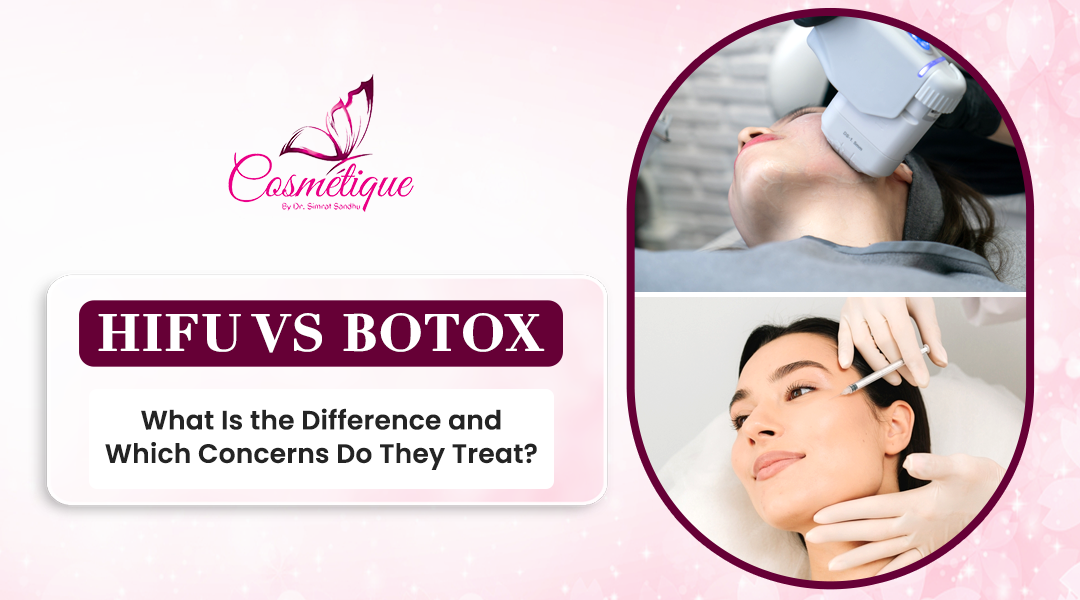
HIFU vs Botox: What Is the Difference and Which Concerns Do They Treat?
Fine lines, loose skin, forehead wrinkles, and changes around the jawline can all appear with age, but they do not develop for the same reason. Some wrinkles form because facial muscles repeatedly move. Others become more noticeable because the skin starts losing firmness.
This is where the HIFU vs Botox comparison becomes useful. Both are non-surgical treatments, but they work differently and are used for different concerns. This blog explains how each treatment works, where they may help, and how the right option is selected.
What Is HIFU?
HIFU stands for High-Intensity Focused Ultrasound. It uses focused ultrasound energy to heat selected layers below the surface of the skin. This controlled heating supports collagen remodelling.
Collagen is a protein that helps give the skin its firmness and structure. As collagen changes over time, the treated area may gradually appear firmer and tighter. HIFU is mainly considered for mild to moderate skin laxity rather than wrinkles caused only by facial muscle movement.
What Is Botox?
Botox is an injectable treatment made from botulinum toxin type A. It temporarily reduces the activity of selected facial muscles. Repeated movements such as frowning, squinting, or raising the eyebrows can create expression lines over time.
Botox works by reducing the muscle movement responsible for these lines. It is commonly considered for areas such as forehead lines, frown lines between the eyebrows, and crow's feet around the eyes.
HIFU vs Botox: What Is the Main Difference?
The main difference between HIFU and Botox is what each treatment targets. HIFU uses ultrasound energy and mainly works on skin firmness and laxity. Botox is injected into selected muscles and mainly works on wrinkles caused by repeated facial expressions.
This means one treatment is not simply a replacement for the other.
Someone with loose skin around the lower face may be more suited to HIFU, while someone with noticeable forehead lines caused by muscle movement may benefit more from Botox.
What Concerns Can HIFU Treat?
HIFU is generally used when loss of skin firmness is the main concern. People considering HIFU treatment in Amritsar may explore this option to address early signs of skin laxity and improve skin firmness. It may be considered for:
- Mild to moderate facial skin laxity
- Reduced definition around the jawline
- Mild sagging around the lower face
- Loose skin around the neck
- Some fine lines and wrinkles
- Early changes in skin firmness
The exact areas treated depend on the person's facial structure and degree of skin laxity.
Does HIFU Help With Wrinkles?
HIFU for wrinkles may be useful when wrinkles are associated with changes in skin firmness and collagen.
The treatment can support tightening and collagen remodelling, which may improve the appearance of some fine lines. However, it works differently from Botox.
A wrinkle that becomes deeper when someone smiles, frowns, or raises the eyebrows is related partly to muscle movement. HIFU does not temporarily relax these facial muscles in the way Botox does.
What Concerns Can Botox Treat?
Botox is mainly used for dynamic wrinkles. These are lines that become more noticeable when the facial muscles move. Common areas include the forehead, between the eyebrows and around the eyes. People considering Botox treatment in Amritsar may explore this option to soften the appearance of these expression lines.
Forehead Lines
Horizontal lines can develop across the forehead from repeatedly raising the eyebrows. Botox can reduce the muscle activity that makes these lines more noticeable.
Frown Lines
Vertical lines between the eyebrows are often associated with repeated frowning or squinting. Botox may be used to soften their appearance.
Crow's Feet
These are lines that develop around the outer corners of the eyes, particularly when smiling or squinting. Botox may reduce the muscle movement responsible for these lines.
Is HIFU a Non-Surgical Face Lifting Treatment?
HIFU is sometimes described as a non-surgical face lifting treatment because it may help improve mild skin laxity and facial definition without surgery.
However, it should not be considered equal to a surgical facelift. The degree of improvement is more limited and depends on skin laxity, age, facial structure, and individual response.
For people with early or moderate changes who do not need or want surgery, HIFU may be one option to consider.
What Are the Benefits of HIFU?
The possible benefits of HIFU depend on the concern being treated. These may include:
- Improved skin firmness
- Mild lifting of lax skin
- Better jawline definition in selected patients
- Improvement in some fine lines
- No surgical incisions
- Little or limited recovery time for many patients
Results vary, and HIFU is generally better suited to mild or moderate laxity than advanced sagging.
Who Is an Ideal Candidate for HIFU?
An ideal candidate for HIFU is generally someone with mild to moderate skin laxity who wants gradual tightening without surgery. It may be considered when someone notices early looseness around the jawline, lower face, or neck.
People with marked skin sagging may need a different approach, as a non-surgical treatment cannot produce the same degree of lifting as surgery.
Who May Consider Botox?
Botox may be considered when the main concern is expression-related wrinkles rather than loose skin. This may include someone who notices forehead lines, frown lines, or crow's feet becoming more visible with facial movement.
The muscles involved and the amount of movement vary between people, so treatment needs to be planned according to individual facial anatomy.
Can HIFU and Botox Be Used Together?
In selected cases, yes. HIFU and Botox target different causes of facial ageing. HIFU may be used for skin laxity, while Botox may be used for expression lines.
Someone can therefore have both concerns at the same time. Whether both treatments are needed, and how they should be timed, depends on the areas being treated and the person's facial assessment.
What Are the Possible Side Effects?
Both treatments can cause temporary effects, although they are different. After HIFU, some people may notice redness, tenderness, swelling, or temporary sensitivity in the treated area.
After Botox, there may be mild redness, swelling, tenderness, or bruising around the injection points. Less commonly, temporary weakness of nearby muscles or drooping of the eyelid or brow can occur.
HIFU Treatment in Amritsar or Botox Treatment in Amritsar: Which Should You Choose?
If you are considering HIFU or Botox treatment in Amritsar, your choice should begin with the concern you want to treat. HIFU may be considered when skin laxity and loss of firmness are the main issues. Botox is more suited to selected wrinkles caused by repeated facial muscle movement.
At Cosmetique by Dr Simrat Sandhu, facial movement, skin laxity, wrinkle pattern, and the areas of concern can first be assessed. Treatment can then be planned according to whether HIFU, Botox, or another approach is more suitable.
FAQs
Is HIFU better than Botox for wrinkles?
Not necessarily. HIFU is more suited to laxity-related lines, while Botox targets expression lines caused by muscle movement.
Can Botox tighten loose skin?
Botox does not directly tighten loose skin. It reduces selected muscle activity that causes dynamic wrinkles.
Can HIFU replace Botox?
No. HIFU and Botox treat different concerns and work in different ways, so one treatment does not directly replace the other.
Which treatment has less downtime?
Both are non-surgical treatments with limited downtime, although temporary redness, tenderness, swelling, or bruising can occur.
How do I know whether I need HIFU or Botox?
It depends on your main concern. HIFU is used more for loose skin, while Botox is used more for expression lines.
At what age can someone consider HIFU or Botox?
There is no fixed age for considering HIFU or Botox. The choice depends on skin condition, facial concerns, muscle activity and individual treatment goals. A consultation can help determine whether either treatment is suitable.
Can HIFU and Botox be done together?
Yes, HIFU and Botox may be used as part of a combined treatment plan. Since they address different concerns, a qualified practitioner can suggest the appropriate treatment sequence and timing.
How long do the results of HIFU and Botox last?
The results vary between individuals. Botox results generally last around 3–4 months, while HIFU results may develop gradually over 2–3 months and can last around 6–12 months, depending on skin condition and individual response.